Guidance on healthcare reform, with more guidance in the forecast

Thanksgiving week was busy on the healthcare-reform front. The Department of Health and Human Services (HHS) released its proposed final rule on Standards Related to Essential Health Benefits (EHB), Actuarial Value (AV), and Accreditation. While there are still questions outstanding, this proposed final rule answered several dental-related questions raised in past blogs.

One of the basic issues with the pediatric oral EHB is the definition of “pediatric.” HHS is proposing that “pediatric” be defined as under age 19, with flexibility for states to extend pediatric coverage beyond this limit.

This is reasonable; while the clinical definition of pediatric is closer to age 13, under age 19 is consistent with social programs, including CHIP.

The proposed rule also clarifies coordination of benefits between medical and standalone dental plans. The 10 EHBs are subject to an out-of-pocket limit, but coordinating this between medical and standalone dental carriers would be complicated and expensive. As a result, standalone pediatric oral dental will have a separate limit from the medical plan. This eliminates the complexity of coordinating these limits and makes it much easier for the consumer to understand. The rule was not clear on what the separate limit will be, but the rule specifies it must be “reasonable” and is requesting comments.

The exact mix of dental benefits included in the EHB is critical. Wisconsin has defaulted to the FEDVIP plan to outline the pediatric oral-health EHB, but this decision won’t be final until the end of the 30-day comment period, or Dec. 26, 2012. Wisconsin could still go with the state’s CHIP plan — a plan we prefer as a benchmark because it’s designed specifically for children. Either way, the benchmark will be finalized by the end of December and we will be ready.

A key clarification in the released rule was that cosmetic orthodontia will not be part of the EHB. Going forward, orthodontia will remain a choice and not a requirement — great for consumers, since cosmetic orthodontia adds significant cost.

The benchmark plan defines only the specific procedures covered, not the coverage level for these procedures (except that preventive must be covered at 100%). The coverage level is defined through the AV. The proposed final rule outlines how AV will be applied to standalone dental plans satisfying the pediatric-oral-EHB requirement.

Standalone dental plans will calculate AV independently of the other EHBs and will be subject to different AV requirements. Under the standalone dental EHB, a high plan will have an AV of 85% and a low plan an AV of 75%.

Similar to the medical AV calculation, the dental AV calculation has an allowed variance of +/- 2%. Unfortunately, unlike medical, there will not be a standard calculator, so challenges remain. Plans with the same benefit design could have different AV, or plans with different benefit designs could have the same AV, making AV an inexact comparison measure for dental plans. Additionally, if the pediatric oral EHB is embedded in the medical plan, it does not appear the dental AV will be calculated separately, making it very difficult to compare the dental EHB benefit embedded in a medical plan to the EHB offered through a standalone dental plan.

There is a lot of work to do over the next several months to get ready for HCR, but clarification on these core issues goes a long way in keeping the process moving. You can count on us to stay engaged and informed on dental issues, and we will continue to be your go-to HCR resource for dental.

The Value of a Healthy Smile

So what is the actual value of good oral health? We live in a time and place that likes to put dollar signs on everything, so let’s try to put a dollar sign on a healthy smile. It’s not too hard.

Value to the Individual

You’ve heard the adage that a picture is worth a thousand words? Well, a smile can be worth thousands of dollars. A recent study shows that more than half of respondents said a healthy smile made them more likely to be hired and receive a larger salary offer.

So let’s say the larger salary offer is in the range of 5 percent. AOL puts the average starting salary for 2012 college graduates at $44,259. Five percent of that is more than $2,200. Extrapolating that salary differential over 30 years and accounting for a 3.5 percent raise each year produces a big number.

Payoff to the individual: $114,238 over 30 years.


Value to the Employer

Dental-related work absences account for an annual loss of 164 million hours in productivity. The Bureau of Labor Statistics puts the average hourly wage at $23.58. You can do the math from here.

Payoff to all employers: $3.867 billion annually.


Value to our Future – Children and Communities

Poor oral health among children has been linked to lower academic performance, so let’s suppose that poor oral health keeps two kids per class per year from going to college. The $44,000 annual average salary for college grads drops to $21,000 for high-school grads.

The BLS estimates the income differential between high-school grads and college grads at more than $900,000 over a working lifetime. Take that figure, multiply it by 3 million kids who don’t go to college because of poor oral health, throw in a couple of billion dollars in social costs stemming from lower levels of education, and you begin to understand why Delta Dental of Wisconsin donates hundreds of thousands of dollars each year to improve kids’ oral health.

Payoff to society: $60 billion-plus annually.


Total Value

The total value is, as you might guess, a very large number.

Through its charitable contributions and its innovative employee-benefits plans, Delta Dental of Wisconsin is working hard to help protect the healthy smiles of millions of Wisconsin residents, all across the state. We understand what’s at stake.

So the next time someone tells you that a healthy smile is priceless, you may want to correct them. It’s not exactly priceless, but it is very, very valuable.

The Actual Value of Actuarial Value

Actuarial value (AV) is being talked about a lot as part of the Affordable Care Act (ACA) and healthcare reform (HCR). Here’s the information we promised on AV and how it affects dental.

Let’s start by defining two key terms used in the HCR discussion: actuarial value and actuarial equivalence.  Actuarial value refers to the average share of covered services paid by a plan for a given population relative to the total average spending for the same population on the same covered services. Plans with the same AV are actuarially equivalent.

Here’s what that means: For an average population, if the total claims expense was expected to be $100 and the plan was expected to pay $80 on average, then the AV would be 80 percent.

You can see how actuarially equivalent plans may not necessarily have the same benefit designs or the same premiums, or how plans with the same benefit design from different companies could have different AV. AV is simply a measure of what portion of the total claims expense, on average, is expected to be paid by the plan.

At this point you may be wondering why you should care about AV. The reason is that AV is the main approach for comparing plans and determining the relative richness of benefits under the ACA.

The ACA requires small-group and individual health plans to meet certain levels of coverage whether they are on or off the exchange. These coverage levels are often called “metal tiers” because they have been defined as bronze (60% AV), silver (70% AV), gold (80% AV), and platinum (90% AV).

The Department of Health and Human Services, in conjunction with organizations like the American Academy of Actuaries, is developing a publically available AV calculator that will standardize population and utilization patterns, minimizing the issue of plans with the same benefit design having different AV.

This sounds great. So what’s the catch?

The catch is dental. Pediatric oral care is part of the required Essential Health Benefits (EHB), and AV applies to the total EHB, not each separate benefit that goes into the EHB.

This creates challenges when the pediatric oral EHB is satisfied with a standalone dental plan. First, there is no accepted way of combining and recalculating AV among dental and medical plans. Second, combining AV across these plans could create a situation where a consumer picks separate medical and dental plans that best meet their needs, but their combined AV no longer fits into one of the metal tiers.

Couldn’t each plan meet the AV requirement separately? Yes for the medical plan, but not for the dental plan. Dental plan designs are very different than medical plans; a typical dental plan in today’s market has an AV of about 86 percent.

Dental’s preponderance of preventive services paid at 100 percent and limited use of deductibles makes it hard to design a dental plan at the 70% AV silver tier (the tier used for premium subsidies) without requiring unusual amounts of cost-sharing. This sets up a situation where the coverage would be out-of-step with today’s market and consumer costs would be much too high.

Additionally, the AV calculator currently being developed only includes medical data, so it’s not appropriate for calculating dental AV. Dental AV would not be based on a standardized data set like medical, so plans with the same benefit design could have different AV; this would make it hard to compare plans across companies.

What’s the solution? Delta Dental of Wisconsin recommends exempting the pediatric oral EHB from the AV requirement. AV is a great tool for comparing complex medical plans, but it doesn’t translate well to simpler dental plans.

Whether pediatric oral benefits are embedded in the medical plan or satisfied through a standalone plan, excluding them from AV avoids market confusion and gives consumers the flexibility to choose coverages that best meet their needs.

For more detailed information on AV and actuarial equivalence, check out the following links:

http://www.actuary.org/files/publications/Health%20Reform%20glossary%20080310.pdf

http://www.actuary.org/pdf/health/equivalence_may09.pdf

http://www.actuary.org/pdf/health/Actuarial_Value_Issue_Brief_072211.pdf


Healthcare Reform, Known and Unknown

So how are dental benefits being impacted by healthcare reform, and how will dental benefits change as the healthcare landscape shifts? There’s plenty to ponder in how everything dental, from copays to crowns, relates to the Affordable Care Act.

And we’ve been doing plenty of pondering. Delta Dental of Wisconsin is actively engaged in the state and national healthcare-reform discussions, and we’ve learned enough about the process where we can be your go-to source for information about dental under healthcare reform.

Let’s start with one important thing we know. Pediatric oral care is one of the 10 essential health benefits (EHB) required to be included as part of health coverage sold in the small-group and individual markets beginning Jan. 1, 2014.

So to the extent that pediatric oral care is part of most dental plans, two important aspects of the dental landscape — your current benefits and the dental-benefits marketplace — have been or will be altered at least to some degree by healthcare reform.

What does that really mean? Great question. Unfortunately, the answer is unclear. We’re still waiting for guidance from the federal Department of Health and Human Services (HHS).

And when we say “guidance,” we mean a lot of guidance, on things that might seem obvious. For example, the term “pediatric” has not yet been defined. From a clinical standpoint, age 12 or 13 is commonly considered the transition away from pediatric care, because that’s when adult teeth have typically replaced baby teeth. Social programs typically cover children to age 19 (the Children’s Health Insurance Program, or “CHIP”) or 21 (Medicaid), and medical plans are now required to cover dependents to age 26.

The final definition of pediatric has pricing and plan-design implications, making it hard to determine impacts on dental until the definition is set.

The exact mix of dental benefits included in the essential health benefits also needs to be determined. HHS gave states flexibility to choose a plan upon which the essential health benefits could be based. Many potential benchmark plans did not include dental coverage, so HHS allowed either the state’s CHIP plan or the Federal Employees Dental and Vision Insurance Program (FEDVIP) dental plan to serve as the benchmark.

We prefer that the Wisconsin CHIP plan be used to define the dental essential health benefits. This is a Wisconsin-developed, tried-and-tested, child-only dental plan that minimizes disruption and balances affordability with appropriate coverage for children. But without clear guidance on what procedures are included in the essential-health-benefits definition, it’s hard to determine exactly how dental is impacted.

While many of the ACA’s market reforms don’t apply to dental, a few key provisions apply to the dental essential health benefits. Preventive services under the essential health benefits must be covered at 100% with no deductible, and while non-preventive services can have deductibles and cost-sharing, no annual or lifetime limits can be applied. Also, annual deductible and out-of-pocket limits apply to all 10 essential health benefits, including dental. We don’t know how these limits will be coordinated, but those decisions will impact both the design and price of the dental essential health benefits.

With healthcare reform, what we know is almost always balanced by what we don’t know. For instance, we know that the ACA will allow standalone dental plans on the insurance exchanges if they provide the pediatric dental essential health benefits and meet other criteria; however, we don’t know whether carriers that embed dental coverage in a medical plan will have to show the dental cost separately. (DDWI supports showing breaking out the dental costs because it lets consumers easily compare plans, increases choice and drives down costs.)

We also don’t know if standalone dental plans that include more than just the essential health benefits will be allowed on the exchange. We think it’s critical to allow expanded dental coverage on the exchange because it will improve access to dental care, increase competition among dental carriers, build on existing coverage, and let parents and children keep their coverage combined.

So summing up, there’s a lot we know about dental’s place in healthcare reform, but there’s also a lot we don’t know – and we haven’t even touched on actuarial value (those pesky bronze, silver, gold, and platinum-level plans). Look for details on actuarial value in a future blog.

What does all this mean? Stay tuned. More updates are coming.

It’s About Service …

Regardless of the industry, every company is in the customer-service business. Every little point of contact with a customer helps build a trusting relationship and makes them glad they’re doing business with you.

At Delta Dental of Wisconsin, we think that using service to gain trust and build our relationship with you are important parts of the “Delta Dental Difference” — whether you’re a broker or agent, dentist or dental-office staff member, representing an employer group or a consumer. We want you to receive great service and be happy that you’ve chosen Delta Dental.

So how do we deliver great service? It’s not just any one thing; a lot of things make the difference, and everyone on the Delta Dental team makes it happen. Here are some examples:

  • When you call our corporate office, a real live person answers the phone. You’re greeted by a friendly voice asking how we may direct your call. You’re not forced to navigate an annoying maze of button-pushing or endless menu options to get service. Just let us know who you want to speak with or what your question is about, and we’ll get you to the right person. 
  • In our award-winning Benefit Center, we receive more than 1,700 calls per day. Our Benefit Advisors are able to help dental-office staff, consumers and employer representatives. They provide professional service and first-call question resolution 99 percent of the time. Did I mention that our Benefit Center has won awards? Oh, yeah! For five consecutive years, we’ve received national recognition and certification as a Center of Excellence from the BenchmarkPortal at Purdue University. 
  • Our Enrollment and Billing team partners with employer groups to ensure the integrity of employee enrollment files and answer billing reconciliation questions. We receive more than 70 percent of enrollment information electronically; that’s a lot of data moving securely back and forth. Our experts make sure that enrollment information is correct, ID cards are promptly sent and billing is timely and accurate. They’re awesome! 
  • Two entire teams are dedicated resources for dentists and dental-office staff. Our Professional Relations and Professional Services teams have years of clinical dental experience; they help with processing issues and complex claim questions. If you have a question about a clinical procedure — let’s say, apexification … who knows what that is? The PR/PS teams have the answer and are happy to help you. These teams also provide educational services through seminars for dental offices and health fairs for our employer groups.

We also have lots of folks working behind the scenes in marketing, finance, underwriting, actuarial services, information technology, data entry, mail, and administrative services. Their coordinated efforts and support keep all systems running smoothly.  Everyone works together to make sure that you get great customer service.

We work hard every day to provide the service you want and to earn your trust as the dental-benefits leader. We want you to be happy that you’ve chosen Delta Dental.

Healthcare-Reform Update: A Smaller FSA

You and your customers may not realize it, but now may be the best time in the foreseeable future for groups to purchase dental benefits for their employees — and the best time for employees not on their group dental plan to opt for group dental coverage.

The reason is a lesser-known facet of the healthcare-reform legislation that cut from $5,000 to $2,500 the amount employees can put into their flexible spending accounts beginning in 2013.

The rationale for the cut was to generate income to fund healthcare reform. The end result is that employees have less tax-free money at their disposal to pay for insurance copays, deductibles, glasses, orthodontia, and prescription drugs.

For employees who used an FSA in lieu of dental insurance to cover dental expenses, and used remaining FSA money to cover other ancillary medical and dental expenses, the halving of the FSA contribution limit means something has to be paid for differently … and that’s where dental insurance comes in.

When a company implements a dental plan and the employees sign up for the plan, the insurance covers the costs that an FSA used to cover, so that reduced FSA money can be spent on other qualified medical expenses and prescription drugs.  The value of a dental-benefits plan is now more tangible than ever for employees.

The other aspect of the relationship between a smaller FSA and dental insurance comes with voluntary dental plans. Upcoming open-enrollment periods are a great time to talk about the $2,500 FSA contribution limit and how voluntary dental insurance can cover many of the expenses once paid out of FSA funds by employees who opted out of the dental plan.

One of the complications created by this regulatory change comes with FSAs that follow something other than a calendar-year cycle. A May 2012 clarification of the regulation implements the $2,500 limit on the plan anniversary, so a program renewing in September 2012 can keep whatever limit it has in place until September 2013, when it must change over to the $2,500 limit.

Finally, the IRS has said it is reconsidering the use-it-or-lose-it provision of health FSAs. The thought is that any rollover would be capped ($500 seems to be the round number under consideration), but even a $500 rollover changes the playing field. Under the scenario under consideration, an FSA rollover can function as a multipurpose rollover account, providing an alternative or a complement to dental annual-maximum rollovers.

Not every employer knows about the FSA change, so it’s a great conversation-starter. And when the conversation shifts to dental benefits, the discussion should focus on how dental insurance can fill a gap left by a shrinking FSA.

Does Bigger Always Mean Better?

When assessing the strength of dental-insurance carriers, most people measure relative strength by the size of a carrier’s network. But is bigger always better – especially if bigger turns out to be not so big after all?

Network size can be measured one of three ways: by access points (the number of dentists practicing at all locations), by unique dentists, or by unique locations. Typically, reporting access points is the most popular method for measuring network strength; however, this provides an opportunity for errors and exaggeration.

One common source of inflated network listings is large multi-location clinics. These clinics typically employ a large number of dentists, with some dentists practicing at more than one location. That on its face does not cause problems; however, some dental-insurance carriers report every dentist associated with a large clinic as practicing at every location the clinic operates. When carriers engage in this practice, it is easy to see how network listings can quickly balloon far beyond what they truly should be.

Other common explanations for network inflation are easy to understand. Dentists can leave practices, move to other locations, get married, change names, retire, or die. While these are all normal life events, many carriers only update their network listings annually, or perhaps even less frequently. Inaccurate listings like this can then get picked up by data-mining services like NetMinder and reported as fact.

This chart delineates the inflation that can occur when carriers are not dedicated to maintaining accurate network listings. The chart shows several carriers’ network listings after being run against a list of verified dentist locations.  Clearly, some carriers are better than others, but it is quite an accomplishment for Carrier A to inflate the size of a dentist network by 495 percent.

Delta Dental of Wisconsin takes network integrity very seriously. Delta Dental network listings are audited several times each year, and appropriate updates to provider listings are made in near real-time. By maintaining good relationships with our network dentists, we are able to call or visit offices to find out which dentists are actually practicing at those locations. Information submitted to us today is on our website tonight.

This type of commitment to accurate reporting – and network-building — has become a valuable point of differentiation for Delta Dental of Wisconsin. We enjoy showing the inner workings and subtleties of network measurement and management to our customers and agent partners. (Want to know more? Contact us.)

Big networks – genuinely big networks — are about more than just big numbers. They’re the end result of longstanding relationships with the dental community, integrity, and the commitment to use networks to deliver value. We’re proud of what our dentist networks represent. We hope you feel the same way.

Ortho To Go

Contrary to perceptions, all children between the ages of 12 and 18 do not have braces – and not every dental plan pays for orthodontia. In fact, trends are headed in the other direction.

Here are the orthodontic-maximum trends in Delta Dental’s book of business over the last decade:

Orthodontic Maximum

2007

2008

2009

2010

2011

Under $1,000

1%

1%

2%

1%

2%

$1,000

21%

20%

23%

23%

21%

$1,200

2%

3%

2%

2%

2%

$1,500

29%

31%

23%

23%

22%

$2,000

4%

4%

6%

6%

6%

Other

2%

2%

4%

4%

4%

None

41%

39%

40%

41%

43%

The ortho-max category that’s grown the most over the last 10 years is “none.” Its growth has consistently come at the expense of the second-most-common ortho max, the $1,500 maximum.

However, the percentage of groups with a $2,000 annual max has tripled over the decade. The percentage of groups with a maximum of “other” (almost always above $1,500, and very often above $2,000) has quadrupled. Factoring in growth in Delta Dental’s book of business, real growth in the number of groups with maximums above $1,500 exceeds 700 percent.

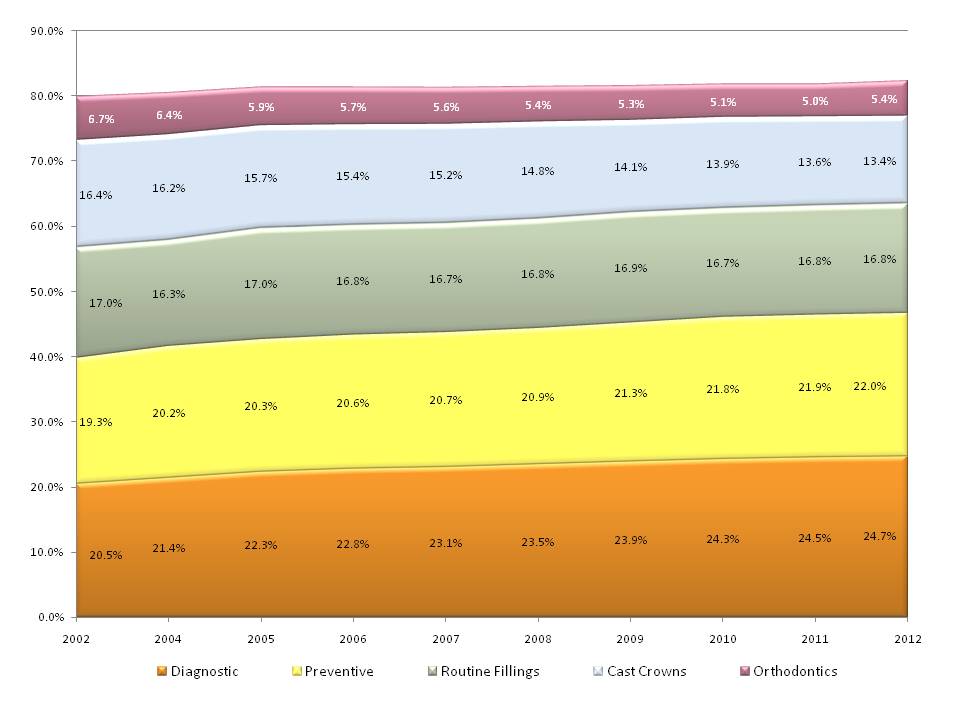
What’s behind the eroding of the middle of the ortho-max class? Cost and utilization. Orthodontia claims make up a smaller percentage of all dental claims. In 2002 they made up 6.9 percent of dental claims; in 2011, they made up 5 percent.  This doesn’t necessarily mean that fewer children are getting braces; it means that the rate of orthodontia procedures is not going up as fast as other procedures. More than 60 percent of children may be getting braces, but there are fewer children, and therefore fewer potential ortho cases.

(There’s also a chicken-and-egg effect. Fewer ortho claims is also a function of fewer plans covering ortho.)

Also, orthodontia has increased by more than 20 percent over the last decade. Groups that had a $1,500 ortho max in 2002 would have to have a $1,800 max in 2012 just to keep up with dental cost inflation.

Groups with ortho expecting high utilization from their members may find value in paying an extra 4 percent for a higher ortho annual maximum.

At any rate, it appears higher ortho annual maximums are here to stay – and no ortho coverage is becoming the standard for most dental plans.

Our Dentists, Our Networks

One of the distinguishing characteristics of Delta Dental of Wisconsin is that we have two dentist networks available to our more than 1.5 million members. We offer a PPO like most other insurance companies and, as an added benefit, we offer the Delta Dental Premier network.

The Delta Dental Premier network, with more than 3,800 places to access care, is the state’s largest dentist network. The Delta Dental PPO network has close to 1,800 access points, and gives you more places to access care than any other state PPO network.

Dentists in the Delta Dental Premier and Delta Dental PPO networks accept a set fee ceiling and will not charge a Delta Dental patient more than the agreed-upon fee. Delta Dental PPO dentists provide a greater discount, creating more cost savings for members. In addition, dentists in both networks agree to service guarantees and standardized claim processing policies, and provide quality care while keeping costs down.

Credentialing is required. All Delta Dental Premier and Delta Dental PPO dentists must meet Delta Dental’s high credentialing standards in order to maintain their network status.  All required elements are reviewed and updated regularly, giving you the assurance that every network dentist meets the highest standards for care and service.

Delta Dental’s Professional Relations team is dedicated to working with dentists, so that a network dentist has a clear and complete understanding of what their network status means. By creating relationships with dentists and their staff, the Delta Dental Premier network and Delta Dental PPO network have grown annually by 1 percent and 4 percent, respectively, over the past several years.

In a recent dentist survey, dentists and staff gave Delta Dental high marks for personal service, continuing-education opportunities, flexibility and claims processing with fast payment.

Delta Dental Premier and Delta Dental PPO dentists partner with Delta Dental to make our dental-benefit programs successful and enable positive oral health.

The Voluntary Difference

Nearly every day there’s a new article or study indicating that even more workplace benefits are being offered on a voluntary basis, making voluntary benefits the fastest growing segment of the employee-benefits market. This is a significant paradigm shift.

So what exactly does “voluntary” mean, and what are Delta Dental’s strategies for this important market segment?

Delta Dental defines voluntary dental insurance as a plan where more than 50 percent of the premium is paid by the employee. Not surprisingly, the sluggish economy of the past few years has spurred an increase in the number of employers who are offering benefits on a voluntary basis.

It’s an interesting dynamic. Many employers can’t afford to continue absorbing the cost of their current employer-paid dental program, even though dental benefits are a tremendous investment in preventive healthcare. And employees want dental insurance; it consistently ranks as the No. 1 benefit employees ask for after health coverage. Dental benefits are good for employees’ health and productivity, so it’s imperative that employers can provide comprehensive dental coverage to their employees – no matter who pays for it.

Enter Delta Dental, and our broadened communication efforts and significant additions to our product portfolio. You may have already read about our product enhancements geared toward the small-group market, including a Table of Allowances plan and MAC (Maximum Allowable Charge) plan options for several existing PPO plans. These plans are also well-suited for the voluntary environment. As the state’s No. 1 dental-benefits provider, we want to ensure that the plans most appealing to agents, employers, and employees are available – and within budget.

Improved employee communications are imperative to success in the voluntary market. Choosing to purchase voluntary dental insurance is a major decision; more than ever we need to educate and engage the end user—the employee – on the product’s benefits. So we’ve unveiled a comprehensive suite of materials – email campaigns, payroll stuffers, posters, and more – that can be given to employees before and during the enrollment process. These materials carry employees right up to the enrollment meeting, where they’ll receive new enrollment packets specifically designed to answer the questions we most frequently receive in a voluntary setting.

As the voluntary market continues to evolve, we will continue to evaluate the market for the dental-benefits products best-suited for Wisconsin, and keep establishing best practices for the entire enrollment process.

We’re offering more products … more tools … more reasons than ever for the voluntary market to experience the Delta Dental Difference.